March 23, 2026
Top Cybersecurity Audits Every SaaS Company Should Prepare For
Top Cybersecurity Audits Every SaaS Company Should Prepare For

Omair


AI applications rely on complex supply chains, including datasets, third-party APIs, and software dependencies.
Securing the AI supply chain is essential to prevent data breaches, model compromise, and operational disruption. Enterprises must implement governance, monitoring, and best practices for end-to-end protection.
AI supply chain security is critical because vulnerabilities in data, APIs, or dependencies can compromise model integrity, expose sensitive information, and disrupt operations.
Unsecured AI components increase regulatory and reputational risks, especially in high-stakes industries like finance, healthcare, and energy.
AI supply chains face multiple security risks, including:
Securing AI data requires protection throughout its lifecycle. Key practices include:
Effective data security ensures model reliability and regulatory compliance.
Several frameworks support structured AI supply chain security:
Applying these frameworks reduces vulnerabilities across AI operations.
API security is essential to prevent unauthorized access and data leaks. Recommended measures include:
Securing APIs ensures that AI services operate reliably and safely.
Dependencies can introduce hidden vulnerabilities into AI systems. Third-party libraries may contain security flaws, outdated code, or malware.
Regular dependency scanning, patching, and supply chain verification prevent exploits that could compromise models or downstream applications.
Dependency management minimizes risk through:
These practices prevent attacks from indirect supply chain weaknesses.
Governance provides structure and accountability for AI supply chain security. Key elements include:
Strong governance ensures that security measures are consistently applied.
Threat modeling identifies potential attack paths across data, APIs, and dependencies. Enterprises evaluate:
This enables proactive mitigation strategies and informed risk management.
Metrics provide insights into security posture and risk reduction. Key metrics include:
Tracking these metrics supports continuous improvement.
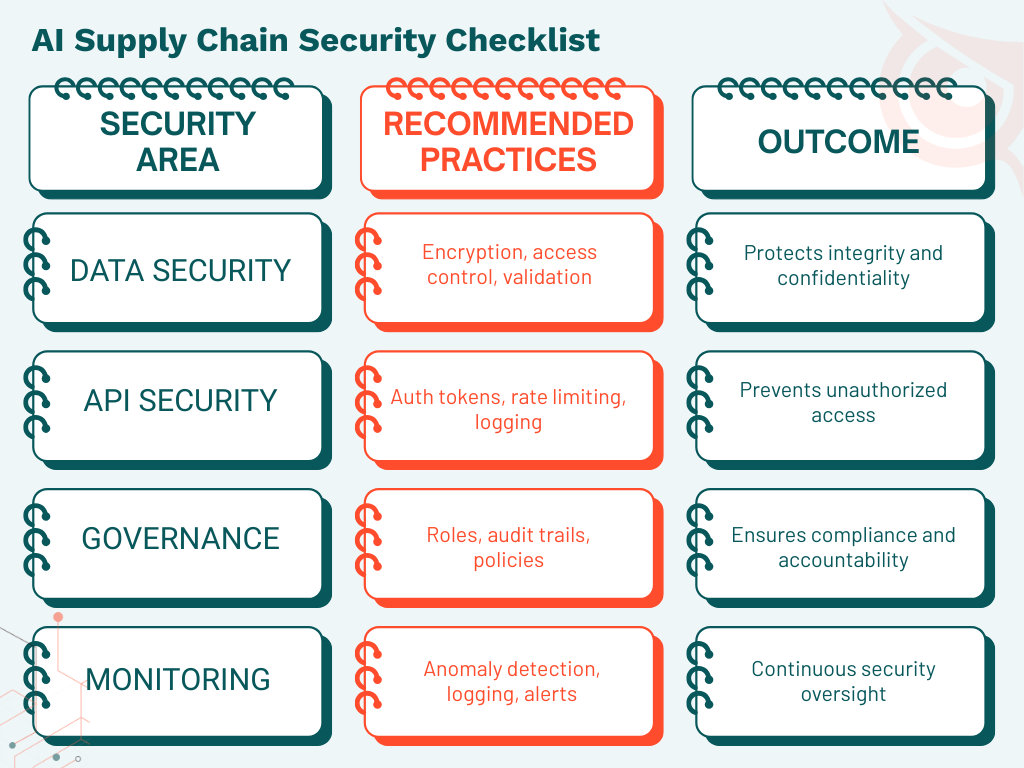
This checklist guides enterprises through comprehensive AI supply chain assessments.
ioSENTRIX offers enterprise-grade services to secure AI data, APIs, and dependencies:
Our approach reduces supply chain risks and strengthens enterprise AI resilience.
Securing the AI supply chain requires end-to-end protection of data, APIs, and dependencies. Implementing best practices, monitoring, governance, and threat modeling ensures enterprise AI is safe, reliable, and compliant. ioSENTRIX provides expert-led solutions for sustainable AI supply chain security.
Protect your enterprise AI supply chain today. Partner with ioSENTRIX for comprehensive security assessments, dependency monitoring, and governance implementation.
Book an appointment to safeguard your AI systems from data breaches and operational risks.
AI supply chain security is the practice of protecting data, APIs, and dependencies used in AI systems to prevent breaches, model compromise, and operational disruption while maintaining compliance with enterprise and regulatory standards.
Enterprises secure AI data by encrypting datasets, implementing access controls, validating inputs, and monitoring for anomalies. These measures ensure model integrity, prevent data leakage, and support compliance with SOC 2, ISO 27001, and HIPAA.
Best practices include authentication and authorization, rate limiting, endpoint verification, and continuous monitoring. Securing APIs prevents unauthorized access, protects sensitive information, and maintains the reliability of AI-driven applications.
Dependency management is important because third-party libraries and packages can introduce vulnerabilities or malware. Scanning, patching, version control, and whitelist management reduce hidden risks in AI supply chains.
Governance defines roles, audit trails, and policies for data, APIs, and dependencies. Strong governance ensures consistent application of security measures, supports compliance, and reduces regulatory and operational risks.