February 12, 2026
AI Governance 2026: New Standards and Compliance Rules
AI Governance 2026: New Standards and Compliance Rules

Fiza Nadeem


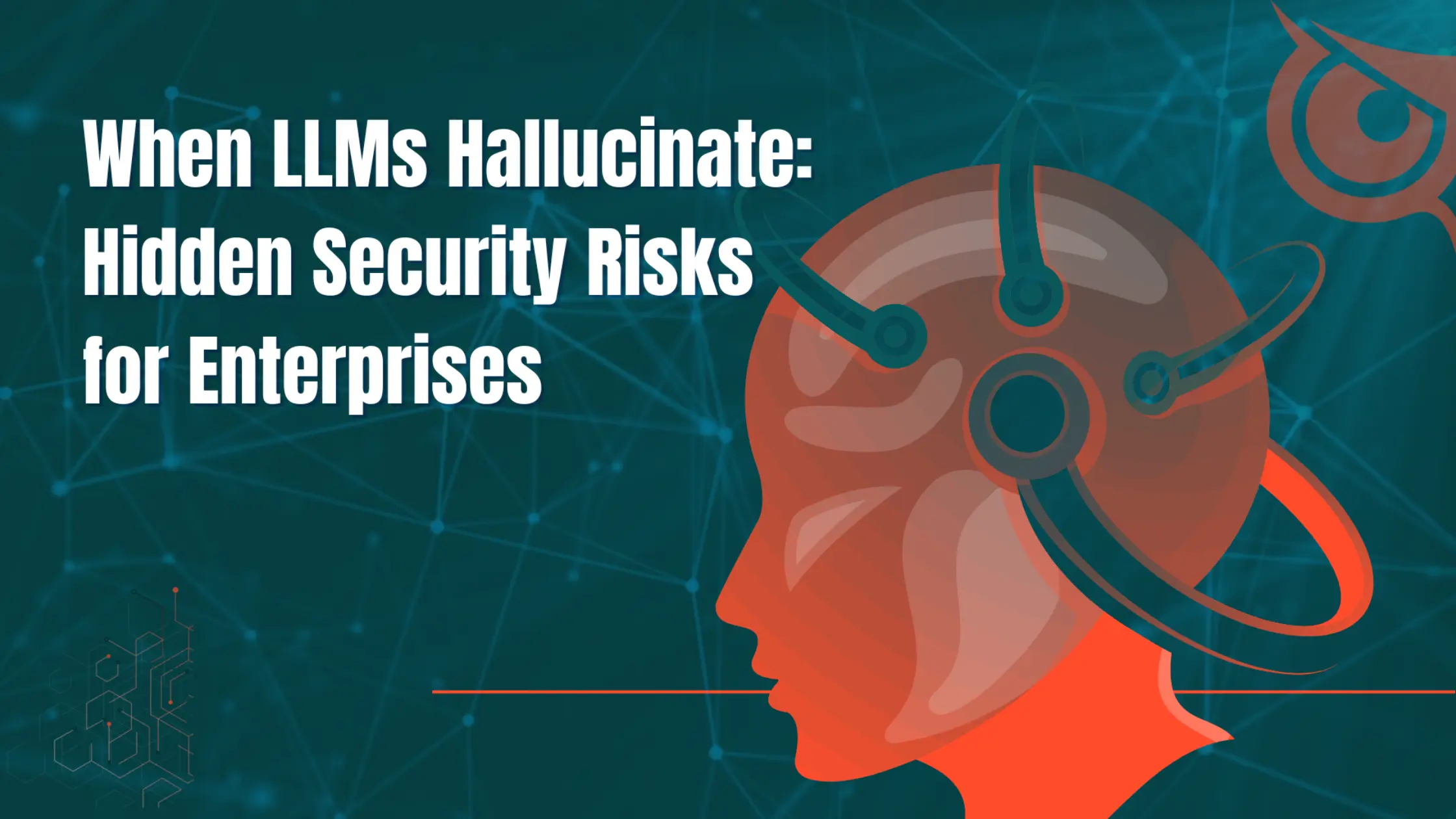
Large Language Models (LLMs) are now embedded in security operations, customer support, developer workflows, and decision systems.
However, LLM hallucinations introduce measurable security, compliance, and operational risks that most mid-market organizations are not prepared to detect or contain.
This article explains why hallucinations matter, how they translate into security incidents, and how ioSENTRIX mitigates these risks through continuous security and AI threat modeling.
LLM hallucinations create security risks because systems generate false but plausible outputs that are treated as trusted data.
According to Stanford HAI research, hallucination rates in production LLMs range from 3% to 27%, depending on task complexity and prompt structure.
In security-sensitive workflows, even a 1% error rate can lead to policy violations, data exposure, or incorrect remediation actions.
Mid-market companies increasingly deploy LLMs without full validation layers. This creates blind trust in outputs that were never verified against authoritative sources.
When hallucinated outputs are logged, stored, or acted upon automatically, they become attack vectors rather than productivity tools.
Hallucinations become incidents when they influence decisions, automate actions, or expose sensitive information.
For example, an LLM used in SOC triage may fabricate threat intelligence sources or misclassify benign traffic as malicious. If remediation is automated, production systems may be disrupted without a real threat.
In regulated sectors like fintech and gaming, hallucinated compliance guidance can cause reporting errors. A single incorrect regulatory reference can trigger audit failures or fines.
According to IBM’s Cost of a Data Breach report, human and system errors contribute to 24% of breaches, and LLM hallucinations now amplify this risk.
For context on breach impact, read: Biggest Data Breaches History.
Mid-market systems are vulnerable when LLMs are embedded without validation, monitoring, or threat modeling.
Common exposure points include:
.webp)
Mid-market companies often lack dedicated AI governance teams. As a result, hallucination risks remain undocumented and unmanaged.
Hallucinations evade detection because they appear linguistically correct while being factually wrong. Traditional security tools detect known patterns, signatures, or behaviors. Hallucinations produce novel, context-aware text that bypasses rule-based controls.
Unlike SQL injection or malware, hallucinations do not trigger alerts. They blend into logs, reports, and dashboards. Over time, organizations unknowingly train internal processes on incorrect information, compounding risk across teams.
This challenge increases when LLMs are connected to APIs, internal databases, or transaction systems.
LLM hallucinations increase operational costs, incident response time, and compliance exposure. Gartner estimates that by 2026, 30% of enterprise AI projects will be abandoned due to data quality and trust issues.
For mid-market organizations, this translates into wasted investment and delayed digital initiatives.
Operational impacts include incorrect incident escalation, false positives, and delayed real threat detection. Financially, these issues lead to downtime, customer churn, and regulatory scrutiny.
In gaming platforms, hallucinated transaction logic can disrupt secure payment flows.
Related insight: Secure Transaction in Gaming
Hallucinations increase compliance risk by generating inaccurate interpretations of regulations and controls.
LLMs may confidently reference outdated frameworks or fabricate control requirements. In audits, this creates gaps between documented processes and actual regulatory expectations.
For financial institutions using FFIEC CAT or similar tools, hallucinated guidance can invalidate assessments. Regulators expect traceability, not probabilistic outputs.
Hallucination risks are reduced through layered controls, validation pipelines, and continuous security testing.
.webp)
ioSENTRIX integrates these controls into its continuous security and PTaaS frameworks, ensuring hallucinations are treated as testable risk vectors.
Continuous security is essential because LLM behavior changes with data, prompts, and integrations.
Point-in-time assessments cannot capture evolving hallucination patterns. Each model update or prompt change introduces new failure modes.
ioSENTRIX provides continuous validation across AI pipelines, APIs, and downstream systems. This approach aligns security testing with real operational conditions rather than static assumptions.
Organizations without continuous testing experience delayed detection and higher breach impact. For early-stage organizations, read: Startup Security Roadmap.
ioSENTRIX addresses hallucination risks by combining AI threat modeling, continuous testing, and real-world attack simulation. Unlike generic security vendors, ioSENTRIX treats LLMs as active components of the attack surface.
This enables:
ioSENTRIX is not an add-on solution. It is a security-first AI assurance platform designed for modern, AI-enabled organizations.
Get expert guidance from ioSENTRIX.
LLM hallucinations are not accuracy issues; they are security risks with measurable impact.
Mid-market organizations adopting AI without continuous security controls expose themselves to silent failures, compliance violations, and operational disruption.
ioSENTRIX enables organizations to deploy AI confidently by validating behavior, reducing blind trust, and securing AI systems end to end. Addressing hallucinations early prevents costly incidents later.